Interactive Sudoku Technique
Sudoku Pairs, Triples, and Quads: Naked and Hidden Sets
Some useful groups sit in plain sight. Others are buried beneath extra candidate marks. Learning to recognize both kinds helps you clear away candidates without guessing.
The Idea in Plain English
When Digits Belong to Certain Cells, Other Candidates Must Move Aside
Look within one row, one column, or one box. If two digits must fit into the same two cells, those two cells belong to that pair. The same idea works with three digits in three cells and four digits in four cells.
You do not need to know which digit goes into which cell. Knowing that the group must stay together is enough to remove candidates that compete with it.
Two Ways to Notice a Set
Naked Sets Show the Cells; Hidden Sets Show the Digits
Naked Pair, Triple, or Quad
The cells show only the digits that belong to the group. A Naked Pair often looks like two cells carrying the same two candidates. Since those digits must occupy those cells, remove them from other cells in the same row, column, or box.
Triples and Quads do not need identical candidate marks in every cell. Taken together, the group simply has no room for any digits outside the set.
Start Here
How to Find a Hidden Pair
- Choose one row, column, or box and scan its candidate marks.
- Look for two digits that each appear in only the same two cells.
- Ignore the extra candidates written in those two cells.
- Keep the pair and remove those extra candidates.
Interactive Example 1 of 3
Remove What Does Not Belong
Select every candidate removed by one complete valid Set or solving route, then check your answer. Selection order does not matter.
One Set Can Reveal Another
The Larger Pattern May Lead You to a Buried Pair
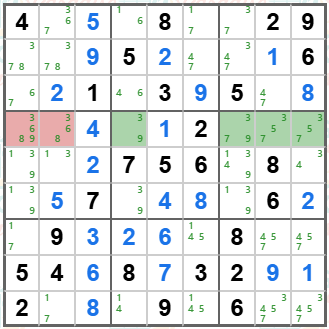
While looking for sets, you may notice that what appears to be a larger set actually exposes a smaller set buried among the other candidates—often a Hidden Pair.
In Row 4, the candidates 3, 5, and 7 attract attention around
r4c7, r4c8, and r4c9.
They cannot form a Triple because r4c7 also contains 9.
-
Add
r4c4, containing 3 and 9. The four cellsr4c4,r4c7,r4c8, andr4c9now form a Naked Quad using 3, 5, 7, and 9. -
The Quad removes 3 and 9 from
r4c1, and removes 3 fromr4c2. - Both remaining cells are reduced to 6 and 8. The cleanup has exposed a Naked 6–8 Pair—but 6 and 8 were a Hidden Pair in those two cells all along.
Use the larger shape as a clue, not as proof. Before removing anything, confirm that the smaller digits truly appear in only those cells within the row, column, or box.
SudokuParadise Real-Game Example
Follow One Productive Scan
Three Pairs and a Glimpse of Something More Advanced
-
The blue 7–9 Pair: In Row 3,
r3c1andr3c4contain only 7 and 9. Those digits can be removed from the other cells in Row 3. -
The green 5–6 Pair: In the same row,
r3c7andr3c9contain only 5 and 6. -
The buried golden 3–8 Pair: After the other two
Pairs account for 5, 6, 7, and 9, the remaining unsolved cells
r3c3andr3c6must contain 3 and 8. Remove 7 fromr3c3, and remove 7 and 9 fromr3c6.
This is why scanning for sets is not always a search for two identical-looking cells. The two obvious Pairs explain most of the row and uncover the Pair that was hidden beneath extra candidates.
One scan, five candidate removals: remove 7 from
r3c3; remove 7 and 9 from r3c6; and remove
5 and 6 from r9c7.
Keep the Difference Straight
Where Do the Eliminations Go?
| What you found | What stays | What you remove |
|---|---|---|
| Naked set | The set's digits inside the set's cells | Those digits from other cells in the same house |
| Hidden set | The hidden digits inside the set's cells | Other digits from the set's own cells |
Interactive Check
Set, Useful Clue, or Near Miss?
Choose the best answer. A promising shape can tell you where to look, but only a complete restriction allows eliminations.
1. Buried Across a Row
In Row 6, digits 2 and 8 appear only in r6c2 and
r6c8. Both cells also contain other candidates.
Choose an answer.
This is a Hidden Pair. The cells may be far apart and may show extra candidates; 2 and 8 are still restricted to those cells.
2. The Third Location
In Box 4, digits 3 and 9 both appear in r4c1 and
r5c2, but digit 9 also appears at r6c3.
Choose an answer.
The extra 9 means the two digits are not confined to the same two cells. It may become a Hidden Pair later, but it is not one now.
3. Nothing Hidden Here
In Column 5, r2c5 and r9c5 each show
only candidates 4 and 7.
Choose an answer.
This is a Naked Pair. The cells themselves display the entire group, so 4 and 7 can be removed from other cells in Column 5.
4. Three Cells, Four Digits
Three cells in a box contain only these combined candidates: 1, 3, 6, and 8. No smaller confirmed set has been found.
Choose an answer.
Three cells cannot lock four possible digits. Treat the shape as a searching clue and inspect the house for a smaller buried set.
What You Learned Today
The Technical Name Is a Subset
You have been finding groups of digits restricted to a matching group of cells. More formally, these groups are called subsets. A Pair is a two-cell subset, a Triple uses three cells, and a Quad uses four.
You do not need that terminology to find them. Later, when you study advanced strategies such as Almost Locked Sets, the word subset will describe something you already know how to see.
Common Questions
Pairs, Triples, and Quads Clarified
Must the cells of a set sit next to one another?
No. They only need to share the same row, column, or box. A Hidden Pair can be spread across opposite ends of a line.
Must every digit appear in every cell of a Triple or Quad?
No. The candidates can be distributed unevenly. What matters is that the complete group is restricted to the correct number of cells.
Why are Hidden Pairs harder to find?
Their two cells usually contain additional candidates, so the pair does not look clean. Search for digits that occur in only the same two places instead of searching for identical cells.
Can a Triple or Quad reveal a Pair?
Yes. A larger visible group can help account for several cells and draw attention to two digits restricted to the cells that remain. Confirm the Pair on its own before eliminating anything.
Continue Practicing
Look for Sets in a Complete Puzzle
Generate a fresh Sudoku, enter a puzzle from another source, or review the candidate discipline that makes hidden sets easier to spot.