Interactive Sudoku Technique
From Two Places to Your First X-Wing
When Singles run out, begin looking for exactly two places. Two carefully aligned two-place restrictions create one of Sudoku's most recognizable advanced patterns: the X-Wing.
The Natural Next Search
After One Place, Look for Two Places
Search for Singles
If a digit has only one possible home in a row, column, or box, place it.
Search for Exactly Two Places
When no Singles remain, scan one digit at a time for a row, column, or box offering exactly two possible homes.
Compare the Two-Place Lines
If two rows use the same two columns—or two columns use the same two rows—the restrictions cross as an X-Wing.
First seek one place. Then seek exactly two places.
One Fact, Three Useful Names
Two Candidates That Cannot Agree
Suppose one digit has exactly two possible homes in a row. The two candidates cannot both be true because the row can contain the digit only once. They cannot both be false because the digit must appear somewhere in that row.
One must be true. One must be false. Knowing which one is true is not important yet.
Bi-Local Candidates
One digit has exactly two possible locations in one house.
Conjugate Pair
The two candidates are partners: exactly one will be true.
Strong Link
If one candidate is false, the other must be true.
Two Strong Links Cross
The X-Wing Works Without Choosing a Diagonal
The first row has two possible homes for the digit. A second row has the same restriction in the same two columns.
If the upper-left corner is true, the lower-right corner must be true. If the upper-right corner is true, the lower-left corner must be true.
We do not need to choose between those diagonals. Either way, each crossing column receives the digit from one of the four corners. No other candidate for that digit can remain in those columns.
Interactive Example 1 of 2
Find the X-Wing Eliminations
This board shows the candidate map for one digit only. The four blue corners form the X-Wing. Select every candidate it eliminates.
A SudokuParadise Case Study
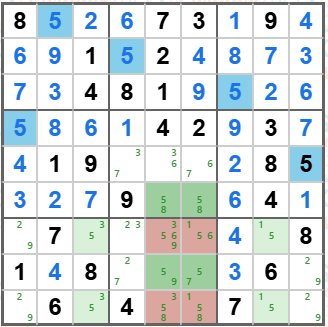
Same Puzzle, Same Eliminations, Different X-Wing
This puzzle contains two independent X-Wings on digit 5. One begins in rows and the other begins in columns. Either proof removes the same four red candidate 5s.

Interactive Check
X-Wing or Not Yet?
Decide whether each description supplies a complete X-Wing. Do not assume unmentioned candidates have already been removed.
1. The Same Two Crossings
In two separate rows, candidate 6 appears exactly twice. In both rows, those two candidates occupy the same two columns.
Choose an answer.
Yes. Two row-based Strong Links cross the same two columns.
2. One Row Has Three Places
Candidate 4 has two positions in one row, but three possible positions in the other row.
Choose an answer.
No. The second row does not provide the required two-place restriction.
3. The Pairs Do Not Line Up
Two rows each contain exactly two candidate 8s, but only one of their columns matches.
Choose an answer.
Not an X-Wing. This near alignment may later help form a Skyscraper, but that belongs to another lesson.
4. Turn the Pattern Sideways
In two separate columns, candidate 3 appears exactly twice. Both columns use the same two rows.
Choose an answer.
Yes. An X-Wing works equally well when its Strong Links begin in columns.
Now Give It Its Technical Name
You Have Found Your First Fish
Advanced Sudoku discussions identify exact cells with row-column
notation. For example, r2c3 means Row 2, Column 3.
An X-Wing might be written as four corners such as
r2c3, r2c8, r7c3, and
r7c8.
In Fish terminology, the two starting rows are called the base sets, and the two crossing columns are the cover sets. The same description can be rotated, beginning with columns and crossing rows.
An X-Wing is the smallest and simplest Fish. You do not need the larger Fish family today. The important achievement is knowing why two crossed Bi-Local Candidate pairs eliminate every competing candidate along their cover lines.
Keep Scanning for Two Places
The Same Habit Will Reveal More Later
Skyscraper
Two parallel Strong Links share only one aligned side.
2-String Kite
A row Strong Link and column Strong Link connect through a box.
Empty Rectangle
A box-line restriction redirects the force of an outside Strong Link.
Those patterns are left for later lessons. Today, make this the natural order of your scan: one place, then exactly two places.
Common Questions
X-Wings Clarified
Must I know which two X-Wing corners are true?
No. Either diagonal supplies one true corner in each crossing line. That certainty is enough to make the eliminations.
Must the two pairs be in rows?
No. Two columns can restrict the digit to the same two rows. It is the same pattern turned sideways.
Can one base row contain a third candidate?
Not for the simple X-Wing taught here. Each base row or column must restrict the selected digit to exactly the two corners.
Why is it called a Fish?
Fish patterns compare groups of base lines with an equal number of cover lines. An X-Wing uses two base lines and two cover lines, making it the smallest Fish.
Continue Practicing
While on the topic of the Wing Family:
Not all Wings are Fish. The Wing Family are built on the Strong Link. See how 3 cells can be Strongly Linked by common candidates.
Continue Practicing
Search a Complete Puzzle for Exactly Two Places
Generate a fresh Sudoku, enter a puzzle from another source, or review the Sets lesson that prepared the way for Strong Links.