Interactive Sudoku Technique
How the W-Wing Connects Two Distant BVCs
Two matching Bivalue Cells cannot reach each other directly. An outside Strong Link carries one candidate between them, guaranteeing the other candidate in one wing or the other.
The Wing Family Finale
This Wing Borrows Its Center
The XY-Wing and XYZ-Wing revolve around a pivot. The W-Wing has no pivot at all. It begins with two separated BVCs containing the same pair, then borrows a Strong Link elsewhere on the grid to make those wings communicate.
The familiar part
The two wings are Bivalue Cells. Each contains the identical pair (X,Y).
The W-Wing difference
A conjugate pair on X connects the wings from a distance and guarantees Y in at least one of them.
Matching wings. One outside Strong Link. Eliminate the other candidate from every cell that sees both wings.
The Borrowed Backbone
The Outside Link Must Be Strong
In the example, candidate 4 appears in exactly two cells of
Column 5: r2c5 and r7c5. One of those
two cells must contain 4. That is a Strong Link—a conjugate pair.
r2c5 contains 4
r7c5 contains 4
The upper endpoint sees Wing A across Row 2. The lower endpoint sees Wing B across Row 7. The endpoints themselves do not need to be BVCs; only their link on candidate 4 must be strong.
Do not mistake the connector cells for extra wings. Their other candidates are irrelevant to this proof. The W-Wing uses two BVCs, not four.
Build One with Real Digits
The Four Parts of the Pattern
Wing A
r2c2
47
Sees the upper 4-link endpoint across Row 2.
Wing B
r7c7
47
Sees the lower 4-link endpoint across Row 7.
Outside Strong Link
r2c5–r7c5
44
These are the only two possible 4s in Column 5.
Victim
r2c7
17
Sees Wing A across Row 2 and Wing B down Column 7.
A Controlled Candidate Map
See the W Before Following the Chain
Only the candidates needed for the proof are shown. Blue and green mark the matching wings, gold marks the two ends of the Strong Link, and red marks the candidate that sees both wings.

r2c2 (4,7) and r7c7 (4,7). One of those
wings must contain 7, so r2c7 cannot contain 7.
Wing A
r2c2 (4,7) starts the proof.
Strong-link endpoints
r2c5 and r7c5 are conjugate on 4.
Wing B
r7c7 (4,7) receives the forced consequence.
Victim
r2c7 sees both wings and loses 7.
If Wing A is 7
The victim already sees a true 7 across Row 2, so its 7 is gone.
If Wing A is 4
The Strong Link carries 4 to the far endpoint, forcing Wing B to be 7. The victim sees that 7 down Column 7.
Wing A is either 7, or it starts a chain that makes Wing B equal 7. Therefore at least one wing is 7, and every common peer loses 7.
A Sudoku Paradise Case Study
The Same W-Wing Inside a Real Puzzle
Here the surrounding candidates make the pattern less obvious. A
preceding Locked Candidates step has already removed 2 from
r6c6, leaving the exact BVC (7,9). It now
matches r9c3 (7,9), so the W-Wing is ready to use.
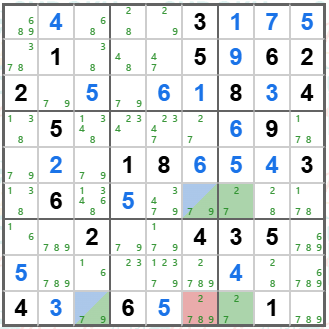
(7,9) wings.
The green cells in Column 7 form the Strong Link on 7, and the
red cell r9c6 sees both wings.
Wing A
r6c6 (7,9) sees the upper link endpoint.
Strong-link endpoints
r6c7 and r9c7 are the only two
possible 7s in Column 7.
Wing B
r9c3 (7,9) sees the lower link endpoint.
Victim
r9c6 sees both wings and loses 9.
If r6c6 is 9
The victim sees that 9 in Column 6, so
r9c6 cannot be 9.
If r6c6 is 7
Then r6c7 is not 7. The Strong Link forces
r9c7 to 7, making r9c3 equal 9. The
victim sees that 9 across Row 9.
Both roads put 9 in one of the two wings. Therefore the common
peer r9c6 cannot contain 9.
Keep the techniques separate: Locked Candidates
prepared the candidate state by removing 2 from
r6c6. The W-Wing begins only after that cell has become
the BVC (7,9).
Reduce It to Five Cells
Watch the Consequence Cross the Grid
The interactive candidate map preserves the exact geometry while stripping away everything unrelated to the chain.
Wing A: r2c2 (4,7)
Strong Link: r2c5–r7c5 (4)
Wing B: r7c7 (4,7)
Victim: r2c7 (1,7)
The victim sees the two wings. It does not need to see either Strong-Link endpoint.
Interactive Either-Or Proof
Give Wing A Either Value
Test both candidates in Wing A. One road is immediate. The other travels through the outside Strong Link before arriving at Wing B.
Both roads guarantee a 7 in one of the two wings:
remove 7 from every candidate cell that sees both wings, including
r2c7.
Your First Compact Chain
Strong and Weak Links Alternate
The ordinary proof is enough to use the W-Wing. The chain notation simply reveals why it is such a natural bridge into longer chaining.
Each BVC supplies an internal Strong Link between 4 and 7. A wing and its nearby connector endpoint cannot both be 4, so those are Weak Links. The center of the chain is the conjugate pair on 4 in Column 5.
Read the chain as a relay: if the left 7 is false, every link forces the next consequence until the right 7 becomes true. The two end 7s cannot both be false.
Now Give It Its Formal Language
The W-Wing Formula
Any outside cell that sees both wings cannot contain Y.
| Role | Cell or house | Candidates | Formal role |
|---|---|---|---|
| Wing A | r2c2 |
4, 7 | (X,Y) |
| Strong Link | Column 5: r2c5–r7c5 |
4 | X = X |
| Wing B | r7c7 |
4, 7 | (X,Y) |
| Victim | r2c7 |
7 removed; 1 remains | Y eliminated |
Interactive Geometry Check
Which Cell Can Lose 7?
The victim must contain 7 and see both BVC wings. It does not need to see the connector cells or the entire Strong Link.
Choose the cell that sees both wings.
Interactive Candidate Practice
Does the Candidate Structure Make a W-Wing?
Assume each Strong-Link endpoint sees its assigned wing and that the two wings do not see each other. Decide whether the pairs and connector digit complete the W-Wing.
0 of 4 examples mastered
The Wing Family in One View
Same Heritage, Three Different Engines
| Technique | Core cells | What supplies the force? | Victim must see |
|---|---|---|---|
| XY-Wing | Three BVCs | A BVC pivot | Both pincers |
| XYZ-Wing | Two BVCs and one trivalue pivot | Three possible pivot values | Pivot and both pincers |
| W-Wing | Two matching BVCs | An outside Strong Link | Both wings |
A Practical Search Order
How to Find a W-Wing
1. Find matching BVCs
Look for two separated cells containing the identical pair (X,Y).
2. Choose a connector digit
Test X or Y for a conjugate pair elsewhere in the grid.
3. Attach one end to each wing
Each Strong-Link endpoint must see a different matching BVC.
4. Intersect the wings' views
Remove the other BVC candidate from every cell that sees both wings.
Before You Eliminate
Check the Entire W-Wing
- The two wings must be genuine BVCs with the identical pair.
- The wings should not see each other; otherwise the pattern reduces to simpler pair logic.
- The outside connector must be a true Strong Link on one wing candidate.
- Each Strong-Link endpoint must see a different wing.
- The candidate eliminated is the other value in the matching BVCs.
- The victim must contain that candidate and see both wings.
- The connector endpoints need not be BVCs.
- The W-Wing eliminates a candidate; any resulting Single belongs to the next step.
Common Questions
W-Wings Clarified
Must a W-Wing look like the letter W?
No. The name does not impose a drawing. Matching BVCs, a valid outside Strong Link, and the required visibility define the pattern.
Are the Strong-Link endpoints also wings?
No. The matching BVCs are the wings. The conjugate endpoints only relay one candidate between them and may contain other candidates.
Can the Strong Link run through a row or box?
Yes. It may occupy any single house—row, column, or box—provided the connector candidate has exactly two possible places there.
Can one W-Wing have more than one victim?
Yes. Eliminate Y from every outside candidate cell that sees both matching wings.
Why is the W-Wing a bridge into chaining?
Its proof already alternates Strong and Weak Links. XY-Chains continue the same relay through a longer series of BVCs.
Continue into Chaining
Now Let the Chain Grow
The XY-Wing introduced the pivot. The XYZ-Wing added a third pivot road. The W-Wing removed the pivot and replaced it with an alternating relay. From here, XY-Chains simply allow that relay to travel through more Bivalue Cells.