Interactive Sudoku Technique
How an XY-Chain Carries Truth Across the Grid
Link a sequence of Bivalue Cells so that every forced candidate triggers the next. When both ends contain the same candidate, one endpoint or the other must be true.
From a Wing to a Chain
You Already Know the Shortest Version
An XY-Wing can be read as a three-cell XY-Chain: one pincer hands a candidate to the pivot, and the pivot hands another candidate to the far pincer. An XY-Chain keeps that relay going through as many Bivalue Cells as the puzzle provides.
The XY-Wing
Three BVCs complete the relay through one pivot.
The XY-Chain
Each additional BVC becomes another link in the same relay.
Begin and end with the same candidate. If the first endpoint is false, the chain must make the other endpoint true.
The Engine Inside Every Link
Every Chain Cell Is a BVC
A Bivalue Cell contains exactly two candidates. One must be true and the other must be false. That exact either-or relationship supplies the Strong Link inside every cell of an XY-Chain.
Inside a BVC
Strong Link
If one candidate is false, the other candidate must be true. The chain notation uses = for this forced turn.
Between BVCs
Weak Link
Two cells that see each other cannot both contain their shared candidate. The notation uses – for this handoff.
The symbols describe logic, not arithmetic. Read 2 = 5 as “if 2 is false here, 5 must be true here.”
A Five-BVC Relay
Follow 7 from One Endpoint to the Other
Endpoint A
r2c2
72
Relay 1
r3c3
25
Relay 2
r3c7
58
Relay 3
r6c7
83
Endpoint B
r6c4
37
A Controlled Candidate Map
See the Relay Before Reading the Notation
Blue marks the two endpoints, gold and green mark the intermediate BVCs, and red marks the illustrated victim. Only the candidates required for the proof are shown.
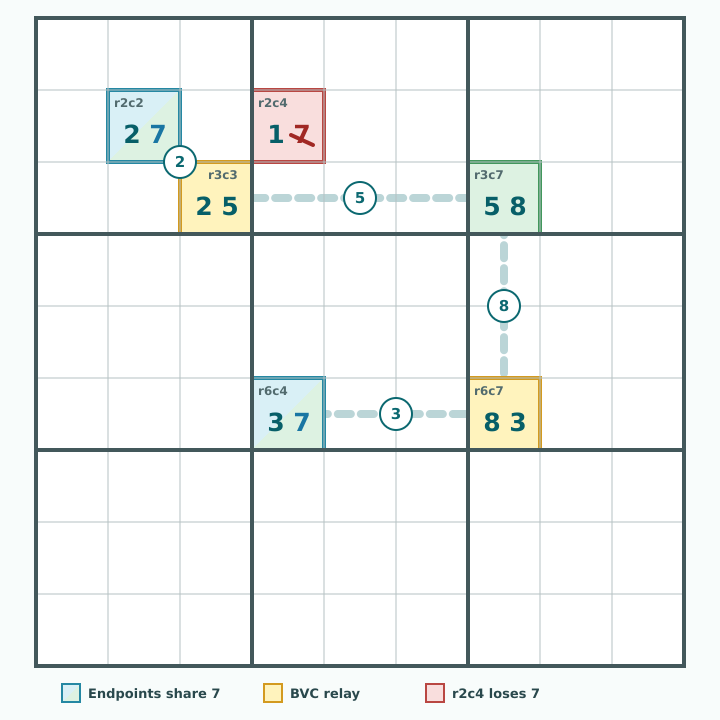
r2c2 is not 7, the chain forces
r6c4 to 7. The red cell r2c4 sees both
endpoints, so it cannot contain 7.
If Endpoint A is 7
The victim sees that 7 across Row 2 and loses 7 immediately.
If Endpoint A is not 7
The relay forces 2 → 5 → 8 → 3 → 7, placing 7 at Endpoint B. The victim sees that 7 down Column 4.
The endpoints cannot both be false for candidate 7. Every candidate cell that sees both endpoints may therefore remove 7.
A Sudoku Paradise Case Study
Eight BVCs Hidden in a Real Puzzle
The controlled example made the relay easy to see. This puzzle shows the real search: eight highlighted BVCs bend through Column 1, double back across Row 7, and then climb Column 5. Their physical order is untidy, but their candidate handoffs are exact.
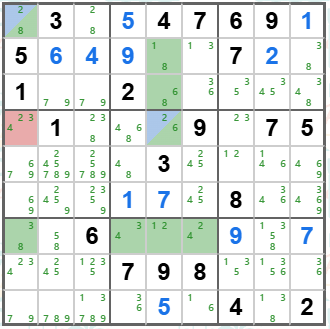
r1c1 (2,8) and
r4c5 (2,6) both contain 2. The red cell
r4c1 sees both endpoints and therefore loses 2.
r1c1
–
(8=3)r7c1
–
(3=4)r7c4
–
(4=2)r7c6
–
(2=1)r7c5
–
(1=8)r2c5
–
(8=6)r3c5
–
(6=2)r4c5
If r1c1 is 2
The victim sees that 2 down Column 1, so
r4c1 cannot contain 2.
If r1c1 is not 2
The BVC relay forces
8 → 3 → 4 → 2 → 1 → 8 → 6 → 2, ending with 2
in r4c5. The victim sees that 2 across Row 4.
One endpoint or the other must contain 2. Therefore
r4c1 ≠ 2. The chain proves only that elimination; any
placement created afterward belongs to the next solving step.
Do not read the colors from left to right. In Row 7
the logical order is r7c1 → r7c4 → r7c6 → r7c5. Follow
the shared candidates, even when the chain doubles back on itself.
Interactive Candidate Map
Advance the Relay One BVC at a Time
Begin by assuming the first endpoint is not 7. Advance the proof to watch each forced value remove the shared candidate from the next BVC.
Endpoints: r2c2 and r6c4
Relay: r3c3 → r3c7 → r6c7
Victim: r2c4 (1,7)
The chain may bend through rows, columns, and boxes. Logical visibility matters; the drawing does not.
Start by declaring candidate 7 false at r2c2.
- At
r2c2, false 7 forces 2. - That 2 removes 2 from
r3c3, forcing 5. - That 5 removes 5 from
r3c7, forcing 8. - That 8 removes 8 from
r6c7, forcing 3. - That 3 removes 3 from
r6c4, forcing 7. - The victim
r2c4sees both endpoint 7s and loses 7.
Interactive Either-Or Proof
Give the First Endpoint Either Value
A valid elimination must survive both possibilities in the first BVC. Test 7 for the short road and 2 for the complete relay.
Both roads guarantee a 7 at one endpoint: remove 7
from every candidate cell that sees r2c2 and
r6c4, including r2c4.
The Chain Written Compactly
Strong Inside, Weak Between
r2c2
–
(2=5)r3c3
–
(5=8)r3c7
–
(8=3)r6c7
–
(3=7)r6c4
Each equals sign is the Strong Link between the two candidates in a BVC. Each dash is the Weak Link between equal candidates in two cells that see one another. The two outside 7s are the endpoints.
| Handoff | From | To | Shared house |
|---|---|---|---|
| 2 | r2c2 |
r3c3 |
Box 1 |
| 5 | r3c3 |
r3c7 |
Row 3 |
| 8 | r3c7 |
r6c7 |
Column 7 |
| 3 | r6c7 |
r6c4 |
Row 6 |
Interactive Endpoint Check
Which Cell Can Lose 7?
The victim must contain the endpoint candidate and see both ends of the chain. It does not need to see any intermediate BVC.
Choose the cell that sees both endpoints.
Interactive Chain Practice
Will the Candidate Relay Reach the Far End?
Assume consecutive cells see each other unless the example says otherwise. Decide whether each sequence forms a standard XY-Chain.
0 of 4 examples mastered
The Simplest Repeating Relative
Remote Pairs Are a Special Chain
A Remote Pair uses an even-length chain of BVCs that all contain the
same pair, such as (2,7)–(2,7)–(2,7)–(2,7). The two
endpoints must take opposite values, so together they contain both
2 and 7.
A candidate cell that sees both Remote Pair endpoints may remove both digits. It is worth recognizing, but it does not need to interrupt the broader XY-Chain lesson.
A Practical Search Order
How to Find an XY-Chain
1. Collect the BVCs
Ignore cells with one, three, or more candidates.
2. Choose an endpoint
Pick one candidate that you hope to reach again elsewhere.
3. Follow each handoff
Move only to a visible BVC containing the outgoing candidate.
4. Recover the endpoint digit
Stop when the far BVC contains the candidate where you began.
5. Intersect the endpoints
Find outside cells containing that digit and seeing both ends.
6. Prove before removing
Trace the implication from the false first endpoint to the true last endpoint.
Before You Eliminate
Check Every Link in the Chain
- Every chain cell must be an unsolved cell with exactly two candidates.
- Consecutive BVCs must see one another and share the handoff candidate.
- Inside each BVC, the received and outgoing candidates must be different.
- The first and last BVCs must contain the same endpoint candidate.
- The endpoints do not need to see each other.
- The victim must contain the endpoint candidate and see both endpoints.
- The victim need not see the middle of the chain.
- An XY-Chain proves an elimination, not which endpoint is true.
- Any resulting Single is a separate next step.
Common Questions
XY-Chains Clarified
Must the cells draw a recognizable shape?
No. The chain may turn through rows, columns, and boxes in any arrangement. Candidate handoffs and visibility define it.
How long can an XY-Chain be?
It may continue through as many valid BVCs as necessary. Longer chains are harder to spot, but their proof is unchanged.
Is an XY-Chain the same as an X-Chain?
No. An X-Chain follows one candidate through Strong and Weak Links around the grid. An XY-Chain changes candidates inside each BVC.
Is an XY-Chain a cycle?
Not necessarily. The two endpoint candidates remain separate. The proof only establishes that they cannot both be false.
Can an XY-Chain have more than one victim?
Yes. Remove the endpoint candidate from every outside candidate cell that sees both ends of the chain.
The Door to Chaining Is Open
Next, Follow One Candidate Instead of Many
The XY-Chain changed candidates inside BVCs while carrying truth across the grid. An X-Chain keeps its attention on one digit and follows that digit through alternating Strong and Weak Links.