Interactive Sudoku Technique
Grouped X-Chains: When Several Candidates Act as One
Follow one digit through alternating Strong and Weak Links. When several candidates occupy the same logical position in the chain, treat the entire group as one node—without pretending to know which member is true.
From XY-Chain to X-Chain
Keep the Chain; Follow Only One Candidate
An XY-Chain changes digits inside Bivalue Cells. An X-Chain does something different: every node represents the same candidate. Its logic travels through the houses that contain that digit.
XY-Chain
Changes candidates inside BVCs, then hands a shared candidate from one cell to the next.
Grouped X-Chain
Follows one candidate through individual positions and through a confined collection that can act as one position.
One digit. Alternating links. Two endpoints that cannot both be false. Every common peer of those endpoints loses that digit.
The Language of the Chain
A Node Is a Logical Claim
Each node answers one question: “Does candidate 6 occupy this position?” Most nodes contain one candidate in one cell. A grouped node makes the broader claim that 6 occupies one of these confined cells.
Single Node
r7c4(6)
One candidate in one cell is either true or false.
Grouped Node
{r8c5, r8c6}(6)
Candidate 6 is somewhere in this confined pair. The chain does not decide which cell contains it.
Outside Candidate
r2c7(6)
A candidate seeing both endpoints becomes the victim.
Shown as =
Strong Link
The two nodes cannot both be false. If one side is false, the other side must contain the digit.
Shown as –
Weak Link
The two nodes cannot both be true. If one side contains the digit, the other side cannot.
The symbols describe implication, not arithmetic. Blue and Green mark alternating phases; neither color is permanently “true.”
A Sudoku Paradise Discovery
Candidate 6 Crosses a Grouped Node
Earlier logical work has already removed the competing 6s that would break the three Strong Links. What remains is an open chain with one grouped position near the far end.
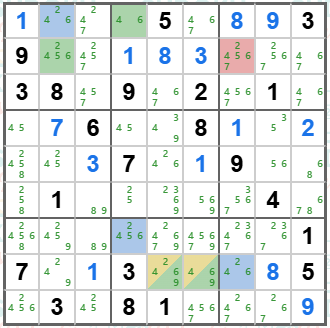
r8c5 and r8c6 form one grouped
node. Blue r8c7 is the far endpoint, and Red
r2c7 is the victim.
r2c2(6)Endpoint A
=
r1c2(6)Column 2
–
r1c4(6)Row 1
=
r7c4(6)Column 4
–
{r8c5,r8c6}(6)One grouped node
=
r8c7(6)Endpoint B
If r2c2 is 6
Red r2c7 sees that endpoint across Row 2, so it
cannot also contain 6.
If r2c2 is not 6
The alternating chain forces 6 into r8c7. Red
r2c7 sees that endpoint down Column 7.
Either way, one endpoint contains 6. Therefore
r2c7 <> 6.
Link by Link
Why Every Connection Is Legal
| Connection | Link | House | What it proves |
|---|---|---|---|
r2c2 = r1c2 |
Strong | Column 2 | These are the only two remaining positions for 6 in the column. |
r1c2 – r1c4 |
Weak | Row 1 | The two positions see each other and cannot both be 6. |
r1c4 = r7c4 |
Strong | Column 4 | These are the only two remaining positions for 6 in the column. |
r7c4 – {r8c5,r8c6} |
Weak | Box 8 | r7c4 sees every member of the grouped node. |
{r8c5,r8c6} = r8c7 |
Strong | Row 8 | Row 8 must place 6 in the group or at r8c7. |
Interactive Implication Trace
Send “Not 6” Through the Chain
Begin by denying 6 at Endpoint A. Advance one connection at a time and watch each Strong or Weak Link determine the next state.
Green phase
Blue phase
Grouped Green node
Elimination victim
A grouped node is false only when candidate 6 is absent from every member of that group.
Start by declaring candidate 6 false at r2c2.
- Deny 6 at
r2c2. - Use the Strong Link in Column 2.
- Cross the Weak Link in Row 1.
- Use the Strong Link in Column 4.
- Cross the Weak Link into the grouped node in Box 8.
- Use the grouped Strong Link in Row 8.
- Remove 6 from the common peer
r2c7.
The Complete Endpoint Proof
Give Endpoint A Both Possible States
The chain never needs to discover which endpoint is 6. It only needs to prove that the endpoints cannot both be false.
Both roads place 6 where r2c7 can see it. Remove 6
from r2c7; do not place either endpoint.
The Essential Restraint
The Group Is True; Its Member Is Unknown
Let G mean “6 is in r8c5 or
r8c6.” The chain may prove G true or G false, but it
never promotes either member without additional logic.
G Is True
One member contains 6
Candidate 6 belongs somewhere inside the group. We still do
not know whether it is in r8c5 or r8c6.
G Is False
Neither member contains 6
Once both grouped candidates are false, the Strong Link in
Row 8 forces 6 into r8c7.
Grouping compresses several candidate positions into one logical statement. It does not solve one of those positions.
Common-Peer Test
Which Candidate Can the Endpoints Eliminate?
Select the cell that sees both r2c2 and
r8c7. Seeing an internal node does not qualify.
Choose a candidate cell.
Link Laboratory
Is the Connection Strong Enough?
Judge the candidate structure, not the shape of the cells. A single overlooked occurrence can change a Strong Link into no link at all.
0 of 4 examples mastered
A Practical Search Order
How to Find a Grouped X-Chain
1. Choose one digit
Ignore every other candidate while tracing the chain.
2. Find a conjugate pair
Begin with a house containing exactly two nodes for the digit.
3. Alternate the links
After Strong comes Weak; after Weak comes Strong.
4. Recognize a group
Confined candidates in a box-line intersection may act collectively.
5. Reach a far endpoint
The chain must begin and end with Strong Links.
6. Intersect the endpoints
Remove the digit only from candidates that see both ends.
Before You Eliminate
Audit the Chain, Not Just Its Appearance
- Every node must represent the same candidate digit.
- The link sequence must alternate Strong–Weak–Strong without interruption.
- The open chain must begin and end with a Strong Link.
- A Strong Link fails if an ungrouped extra candidate remains in its house.
- For a Weak Link to a group, the other node must see every group member.
- All grouped candidates must belong to one valid box-line intersection.
- The victim must contain the chain digit and see both endpoints.
- The chain proves an endpoint truth, not which member of a group is true.
- Any Single exposed by the elimination is a separate next step.
Common Questions
Grouped X-Chains Clarified
Must the cells be Bivalue Cells?
No. Unlike an XY-Chain, this chain follows only one candidate. The other candidates in its cells do not drive the inference.
Does a grouped node mean every member is true?
No. It means the digit belongs somewhere in that group. In a Sudoku house, only one member can eventually contain it.
Why are r8c5 and r8c6 one node?
For this chain, they have the same outside relationships. Both
see r7c4 in Box 8, and together they form one side of
the Strong Link with r8c7 in Row 8.
Is a Grouped X-Chain a Grouped X-Cycle?
No. This is an open path with two distinct endpoints. A cycle closes back upon itself and applies loop rules that deserve their own lesson.
Can the chain eliminate from more than one victim?
Yes. Every outside candidate for the digit that sees both endpoints may be removed.
Why not solve r8c5 or r8c6 when the group is true?
Because the chain proves only the collective statement. Choosing a particular member would claim information the chain never supplied.
From One Candidate to Candidate States
Next, Let the Chain Change Digits
This Grouped X-Chain followed one candidate through individual and grouped positions. An Alternating Inference Chain keeps the same Strong–Weak rhythm, but may move inside a cell to another candidate before continuing through a conjugate house link.