Interactive Sudoku Technique
ALS-XZ: When Two Almost Locked Sets Cooperate
Each Almost Locked Set is one candidate away from becoming a locked set. Connect two of them through a Restricted Common Candidate, and one of the sets must supply their other shared candidate. Any outside candidate that sees every possible source of that shared digit can be eliminated.
From Candidate Paths to Candidate Sets
Let an Entire Set Carry the Inference
An AIC follows individual candidate states through a logical path. ALS-XZ compresses several related cells into a larger logical unit. We no longer ask which exact cell is true first; we ask what the candidate structure of the whole set guarantees.
Candidate-Level AIC
Truth travels from one candidate state to another through alternating inferences.
ALS-XZ
Two nearly locked sets interact through one restricted candidate and force a conclusion about another.
X restricts the relationship between the two ALSs. Z carries the conclusion beyond them.
One Candidate Too Many
What Is an Almost Locked Set?
Choose N unsolved cells within one house. If their combined candidate list contains exactly N+1 distinct digits, those cells form an Almost Locked Set—an ALS.
The Smallest ALS
A Bivalue Cell Is a One-Cell ALS
A BVC contains one cell and two candidates: N cells with N+1 candidates. The BVCs used throughout the Wing Family and XY-Chains were therefore your first Almost Locked Sets—even before we gave them that broader name.
Locked Set
Three cells contain exactly three candidates. Those candidates are already locked into those cells.
Almost Locked Set
Three cells contain four candidates. Rule one candidate digit out of the entire set, and the remaining three become locked.
Count distinct candidate digits, not the number of pencil marks. A digit may appear in several cells and still counts only once in the ALS candidate union.
The Two Named Candidates
X Builds the Restriction; Z Becomes the Elimination
X
Restricted Common Candidate
X occurs in both ALSs, and every X position in one set sees every X position in the other. Therefore X cannot be true in both sets.
Z
Shared Elimination Candidate
Z also occurs in both ALSs. Because X cannot occupy both sets, at least one ALS must contain Z.
¬Z
Outside Victim
An outside Z that sees every possible Z position in both ALSs can see whichever set supplies Z. Remove it.
The victim does not need to see every cell in either ALS. It must see every occurrence of Z in both ALSs.
A Complete ALS-XZ in the Grid
Two Three-Cell ALSs Eliminate 7 from r2c2
The green ALS occupies Row 2. The amber ALS occupies Column 1. Blue identifies every cell containing the Restricted Common Candidate 5. The red cell contains the outside candidate 7 that ALS-XZ will eliminate.
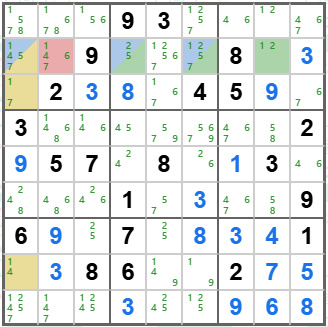
Z visibility is hidden so the original candidate grid remains easy to read.
| Role | Cells | Candidate union | X=5 positions | Z=7 positions |
|---|---|---|---|---|
| ALS-A | r2c4, r2c6, r2c8 |
{1,2,5,7} |
r2c4, r2c6 |
r2c6 |
| ALS-B | r2c1, r3c1, r8c1 |
{1,4,5,7} |
r2c1 |
r2c1, r3c1 |
| RCC X | Every 5 in ALS-A sees every 5 in ALS-B through Row 2. | r2c4/r2c6 ↔ r2c1 |
— | |
| Victim Z | r2c2#7 |
Sees all three supporting 7s through Row 2 and Box 1. | Eliminate 7 | |
Build the Deduction
Five Checks, One Honest Elimination
Advance through the exact information ALS-XZ needs. Each step verifies one condition; none assumes which cell eventually holds X or Z.
- Confirm ALS-A: three cells and four distinct candidates.
- Confirm ALS-B: three cells and four distinct candidates.
- Verify that X=5 is restricted between the two sets.
- Locate every Z=7 and test the victim’s visibility.
- Eliminate candidate 7 from r2c2.
Begin by counting ALS-A’s cells and distinct candidates.
Every requirement is satisfied. Remove 7 from r2c2. ALS-XZ performs the elimination; any resulting Single belongs to the Singles solver.
Why the Rule Works
X Cannot Live in Both Sets
Every possible 5 in ALS-A sees the only possible 5 in ALS-B. Therefore the two sets cannot both contain 5. At least one of them must operate without X—and an ALS without one candidate becomes a locked set containing every remaining candidate, including Z=7.
Road One: ALS-A Has No 5
ALS-A becomes the locked set {1,2,7}. Candidate 7
must appear somewhere in ALS-A; its only position is
r2c6.
Road Two: ALS-B Has No 5
ALS-B becomes the locked set {1,4,7}. Candidate 7
must appear at r2c1 or r3c1.
At least one road must be true, and r2c2#7 sees every
destination on both roads. Therefore r2c2 ≠ 7.
The Same Proof Turned Around
Suppose the Victim Were 7
If r2c2=7, it would remove 7 from every Z position in
both ALSs. ALS-A would become the locked set {1,2,5},
forcing it to contain 5. ALS-B would become
{1,4,5}, also forcing it to contain 5.
r2c2=7assumption
→
7 leaves both ALSsall Zs removed
→
Both require 5X twice
→
ImpossibleRCC conflict
The assumption forces the Restricted Common Candidate into both sets, even though all of their 5 positions see one another across Row 2. Reject the assumption and eliminate 7 from r2c2.
A Disciplined Search
How to Look for ALS-XZ
1. Inventory Small ALSs
Look within one house for two cells with three candidates, or three cells with four candidates.
2. Test Shared Candidates
Find a common digit whose positions are completely restricted between the two ALSs. Call that digit X.
3. Test Every Z Peer
Find another shared digit Z, then inspect outside Zs that see every one of its positions in both sets.
Before accepting the elimination
- Each ALS contains N cells in one house and N+1 distinct candidates.
- X appears in both ALSs.
- Every X in one ALS sees every X in the other.
- Z appears in both ALSs.
- The victim lies outside both ALSs and sees every possible Z.
Check the Structure
Four Quick ALS-XZ Decisions
Count an ALS
Three cells contain the union {1,2,5,7}. Is that an ALS?
Recognize X
What makes a shared candidate an RCC?
Recognize Z
Must Z occupy only one cell in each ALS?
Test the Victim
Which positions must an outside Z see?
0 of 4 decisions confirmed
Questions Worth Asking
ALS-XZ Frequently Asked Questions
Is a Bivalue Cell an ALS?
Yes. One cell containing two candidates satisfies the N cells, N+1 candidates definition. ALS-XZ can therefore include a one-cell ALS, although this example uses two three-cell sets.
Must the two ALSs occupy the same kind of house?
No. Here ALS-A lies in Row 2 while ALS-B lies in Column 1. Each individual set must be contained in a house; the two houses need not match.
Must Z be restricted between the ALSs?
Not for this singly linked ALS-XZ. X is the Restricted Common Candidate. Z may occupy several positions, which is why the victim must see all of them.
Does ALS-XZ determine which ALS contains Z?
No. It proves that at least one ALS contains Z. The victim is eliminated because it conflicts with either possible source.
What is a doubly linked ALS-XZ?
It is a related configuration in which a second common candidate is also restricted between the sets. That stronger relationship supports additional conclusions, but it is not required for the elimination taught here.
Next: Divide the Candidate Budget
Let a Line and Box Share Two Companion Sets
Sue de Coq carries the set-based viewpoint into a box-line intersection. Two companion Almost Locked Sets account for the intersection's two surplus candidates, locking different digit families into the line and box.