Advanced Sudoku Coloring
3D Medusa: When Coloring Escapes a Single Digit
Simple Coloring follows one digit through conjugate pairs. 3D Medusa keeps the same two-state bookkeeping, but it can change digits inside a Bivalue Cell. The result is a connected network of candidate states in which opposite colors represent opposite truth assignments.
From Simple Coloring to Candidate-State Coloring
The Third Dimension Is the Digit
Simple Coloring stays on one candidate digit. A conjugate pair in a row, column, or box supplies a Strong Link, and the colors alternate as that one digit moves through the grid.
3D Medusa adds another kind of Strong Link: the two candidates inside a Bivalue Cell. That cell can carry the coloring from one digit to another.
Simple Coloring
One digit travels through conjugate pairs in houses.
r2c4#6 = r2c9#6
3D Medusa
A house Strong Link may arrive at a Bivalue Cell, where the opposite candidate creates another Strong Link and changes the digit being followed.
r7c8#3 = r7c8#8
Medusa colors candidate states, not whole cells.
r7c8#3 and r7c8#8 are two different
logical nodes even though they occupy the same cell.
What Is Allowed to Carry the Color?
Two Sources of Strong Links
Conjugate pair in a house
If one digit has exactly two remaining positions in a row, column, or box, one of those positions must be true.
Two candidates in a Bivalue Cell
If an unsolved cell contains exactly two candidates, exactly one of those candidates must be true. The two candidate states therefore receive opposite colors.
Walk Through a Real Sudoku Paradise Medusa
A Chain That Changes from 3 to 8
This live position produced a 3D Medusa deduction. Follow the Strong Links from left to right. Each step flips the color.
Begin at r1c5#3. The starting color is arbitrary.
The important turn happens at r7c8:
candidate 3 and candidate 8 are opposite colors in the same
Bivalue Cell. That is where the Medusa changes digits.
Live Example · Rule 5
Two Colors: Unit + Cell
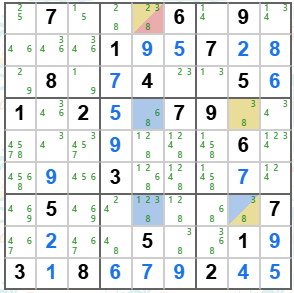
The target is r1c5#8.
If Blue is true
r1c5#3 is true. The same cell cannot also contain
8, so r1c5#8 is false.
If Gold is true
r4c5#8 is true. Column 5 cannot contain another
8, so r1c5#8 is false.
The target loses under either possible color state.
Therefore r1c5 ≠ 8.
This is the defining Rule 5 shape used by Sudoku Paradise: the target conflicts with one color through its own cell and with the opposite color through a row, column, or box.
The Seven Deductions Implemented by Sudoku Paradise
How a Medusa Network Produces Progress
Twice in a Cell
Two candidates of the same color occupy one cell. That color cannot be true.
Twice in a Unit
Two same-colored occurrences of the same digit share a row, column, or box. That color cannot be true.
Two Colors in a Cell
An uncolored candidate conflicts with both colors through its own cell and therefore cannot be true.
Two Colors Elsewhere
An uncolored candidate sees both colors of its own digit in the network and therefore cannot be true.
Two Colors: Unit + Cell
An uncolored candidate conflicts with one color in its own cell and the other color through a house.
Cell Emptied by Color
If assuming one color true defeats every remaining candidate in an uncolored cell, that color is impossible.
Unit Emptied by Color
If assuming one color true defeats every remaining home for a digit in a row, column, or box, that color is impossible.
Rules 1, 2, 6, and 7 disprove an entire color. Rules 3, 4, and 5 directly eliminate an outside candidate that loses under both color states.
Live Example · Rule 1
One Color Appears Twice in the Same Cell

r7c3 with both
r7c3#6 and r7c3#8 carrying the same
color state. One cell cannot contain two digits, so that entire
color is false.
The Strong-Link path that exposes the contradiction travels through several digits:
              r7c3#6 → r9c1#6 → r9c1#4 → r9c6#4 → r9c6#8 →
              r7c5#8 → r3c5#8 → r3c9#8 → r8c9#8 → r8c3#8 →
              r7c3#8
Every arrow in that displayed route is a Strong Link, so the two
Medusa colors alternate at every step. Because the route contains
an even number of color changes, it returns to r7c3
with #6 and #8 carrying the
same color.
The contradiction
If that color were true, r7c3=6 and
r7c3=8 would both be true. A Sudoku cell can hold
only one digit.
The consequence
The contradicted color is false throughout the connected Medusa component. Every candidate carrying that color can be removed.
Sudoku Paradise identifies Color B as the false color in this
position. Candidate r1c8#8 belongs to that defeated
color, so r1c8 ≠ 8.
Notice that the red candidate at r1c8 does not create
the contradiction. The contradiction occurs at r7c3.
Once the color itself is disproved, r1c8#8 is one of
the consequences.
Live Example · Rule 7
One Color Empties a Unit
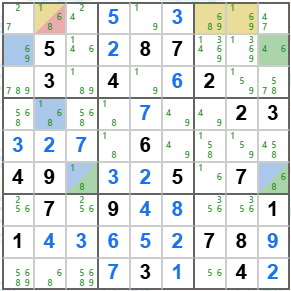
In Row 1, candidate 6 has three remaining homes:
r1c2#6, r1c7#6, and
r1c8#6.
Suppose the tested Medusa color is true:
-
r1c2#1defeatsr1c2#6through the same cell. -
r2c9#6defeatsr1c7#6through Box 3. -
r2c9#6also defeatsr1c8#6through Box 3.
Row 1 would then have no legal place left for digit 6. Sudoku requires every row to contain a 6, so the tested color cannot be the true state.
The entire tested color is false. Sudoku Paradise may therefore
eliminate a candidate carrying that false color, including
r1c2#1.
Strong Links Build It; Weak Conflicts Cash It In
Do Not Confuse the Coloring Network with the Elimination Test
Sudoku Paradise builds the two-color Medusa component from Strong Links:
- conjugate pairs for one digit in a row, column, or box;
- the two candidates inside a Bivalue Cell.
Weak relationships are then used when testing contradictions and targets: same-cell conflicts, same-digit peers in a house, and other candidate conflicts that cannot simultaneously be true.
Strong Links propagate the colors. Weak conflicts prove what the colors eliminate.
A Visual Relative of Inference Chains
How 3D Medusa Relates to AIC
Medusa and Alternating Inference Chains both reason with candidate truth states, Strong relationships, Weak conflicts, and conclusions that survive every permitted truth assignment.
The difference is presentation. An AIC usually writes one alternating proof path. Medusa first colors an entire connected Strong-Link component, then asks what becomes impossible under one color or what outside candidate loses under both colors.
The techniques are therefore closely related without being interchangeable names.
A Reliable Human Routine
How to Look for 3D Medusa
1. Find a Strong-Link network
Start from a conjugate pair or a Bivalue Cell and color the two candidate states oppositely.
2. Propagate only through Strong Links
Continue through conjugate houses and Bivalue Cells. Every Strong Link flips the color.
3. Allow the digit to change
When the path crosses a Bivalue Cell, follow the opposite candidate. This is the step Simple Coloring cannot make.
4. Search for a contradiction or a trapped target
Test same-color conflicts, candidates seeing both colors, and cells or units that one color would empty.
Read the Network, Not Just the Paint
Four Quick Medusa Decisions
Change digits
A colored candidate enters a Bivalue Cell. What lets Medusa move to the other digit?
Read the colors
Does Blue automatically mean true?
Rule 5
A target conflicts with Blue in its own cell and Gold in its column. What follows?
Rule 7
Assuming Gold true would remove every remaining 6 from one row. What follows?
0 of 4 decisions confirmed
Questions Worth Asking
3D Medusa Frequently Asked Questions
Does 3D Medusa color cells?
No. It colors candidate states. A single Bivalue Cell may contain one Blue candidate and one Gold candidate.
Why is it called 3D?
Simple Coloring follows one digit across the two-dimensional grid. 3D Medusa can also move between digits through Bivalue Cells, adding the candidate digit as another logical dimension.
Does every colored component count as 3D Medusa?
No. A component that contains only one digit belongs to Simple Coloring. Medusa becomes genuinely multi-digit when Bivalue Cell Strong Links connect candidate states of different digits.
Is one color assumed true?
No. The colors are opposite possible states. A deduction is accepted only when one state contradicts Sudoku or when a target fails under both states.
Is Medusa guessing?
No. Both color states remain represented simultaneously. The solver does not commit to either state unless the grid proves the opposite state impossible.
How is Medusa different from an AIC?
An AIC presents a particular alternating inference path. Medusa colors a connected Strong-Link component and then searches that component for contradictions and two-color eliminations.
Let the Candidates Carry the Truth States
Color the Candidate, Follow the Strong Link
Start with an either-or relationship. Flip the color across every Strong Link. Let a Bivalue Cell change the digit. Then ask the grid the only question that matters: does one color become impossible, or does an outside candidate lose whichever color survives?